Tutorials
One of the unique features of the PHM conferences is free technical tutorials on various topics in health management taught by industry experts. As educational events, tutorials provide a comprehensive introduction to the state-of-the-art in the tutorial’s topic. Proposed tutorials address the interests of a varied audience: beginners, developers, designers, researchers, practitioners, and decision-makers who wish to learn a given aspect of prognostic health management. Tutorials will focus both on theoretical aspects as well as industrial applications of prognostics. These tutorials reach a good balance between the topic coverage and its relevance to the community. This year’s tutorials cover a range of topics.
| Date and Time: Monday, October 27 | 1:45 PM – 3:15 PM |
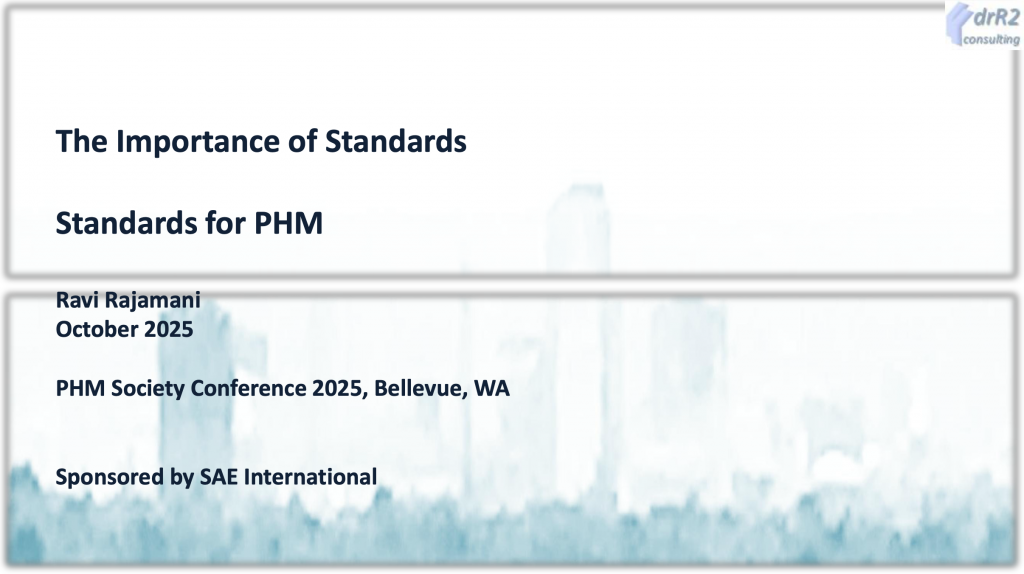
| Tutorial Session 1: The Importance of Standards or Why Your House Has Not Burned Down Yet! |
|---|
| Presenters: Ravi Rajamani, drR2 Consulting
Description: Standards are important for all aspects of design, analysis, testing, and certification of complex engineering systems. In this tutorial we will briefly review the history of engineering standards, the role of standards development organizations (SDO), and the use of standards in PHM. While the emphasis in this talk is on aerospace applications, the precepts discussed are universal. About the Presenter: Dr. Ravi Rajamani is an independent consultant working on applying model-based and data analytical solution techniques to aerospace and other complex systems. He has been active in the field of aerospace propulsion including electric propulsion for over thirty-five years. He has published eight books, many book chapters, journal papers, conference proceedings, and patents. Prior to his current job, Ravi worked at Meggitt (now Parker), UTC (now RTX), and GE. He is active within various SAE standards-setting technical groups, serves as the chair of their Executive Standards Council, and is the editor-in-chief of the SAE International Journal of Aerospace. He is a visiting research professor at the University of Connecticut, is an elected member of the Connecticut Academy of Science & Engineering (CASE), and an elected fellow of SAE and of IMechE. Recently, he assumed the presidency of the Independent Data Consortium for Aviation, developing data governance standards for the aviation industry. Slides:
|
| Date and Time: Tuesday, October 28 | 10:30 AM – 12:00 PM |
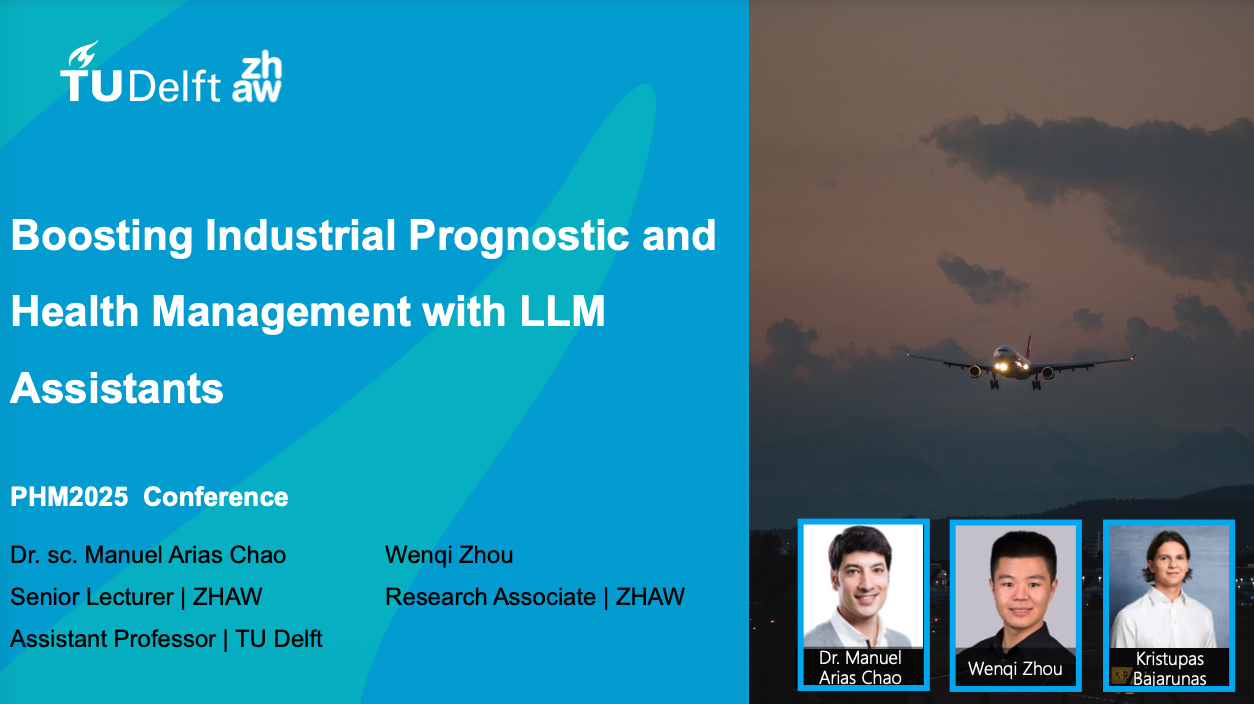
| Tutorial Session 2: Boosting Prognostics and Health Management with LLM Assistants |
|---|
| Presenters: Manuel Arias Chao, TU Delft and Zurich University of Applied Sciences (ZHAW)
Description: Modern maintenance and operations face growing challenges: massive data streams, fragmented documentation, and time-critical decisions. This tutorial introduces how Large Language Models (LLMs) and AI assistants can support Prognostics and Health Management (PHM) by acting as copilots for engineers. We will present a vision of LLM-powered assistants that integrate technical manuals, historical cases, and sensor data with PHM algorithms to support troubleshooting, link alarms with fault signatures, and provide actionable maintenance recommendations. A case study on the CFM56 turbofan engine will illustrate how multi-agent architectures and retrieval-augmented generation (RAG) can transform industrial health monitoring into an interactive, data-driven workflow. The tutorial will also cover the fundamentals of LLMs, RAG, and agent frameworks, with a live demonstration of an AI-PHM assistant prototype. Finally, we will discuss open challenges and research opportunities in multimodal data fusion, robust deployment in industrial settings, and human–AI teaming for maintenance decision-making. About the Presenter: Dr. Manuel Arias Chao is an Assistant Professor in the Operations and Environment Section at TU Delft and a Senior Lecturer in Smart Maintenance at the Zurich University of Applied Sciences (ZHAW). He received his PhD from ETH Zurich, where he specialized in physics-informed machine learning for Prognostics and Health Management (PHM). He also holds an MSc in Thermal Power from Cranfield University and a BSc in Aeronautical Engineering from the Technical University of Madrid. He has gained valuable industrial and research experience as a visiting researcher at the Diagnostics & Prognostics Center of Excellence at NASA Ames, as Thermodynamics & Performance Lead Engineer at General Electric and ALSTOM Power, and as Aero Engine Maintenance Engineer at ITP. In his current role, he co-leads the Smart Maintenance Expert Group within the Swiss Alliance for Data-Intensive Services. His research focuses on AI-powered diagnostics, prognostics, and decision support for critical systems, with applications spanning power generation, marine and aircraft propulsion, and advanced manufacturing equipment. Slides and Video:
Slides PDF (Click on Thumbnail)
|
| Date and Time: Thursday, October 30 | 9:00 am – 10:30 am |
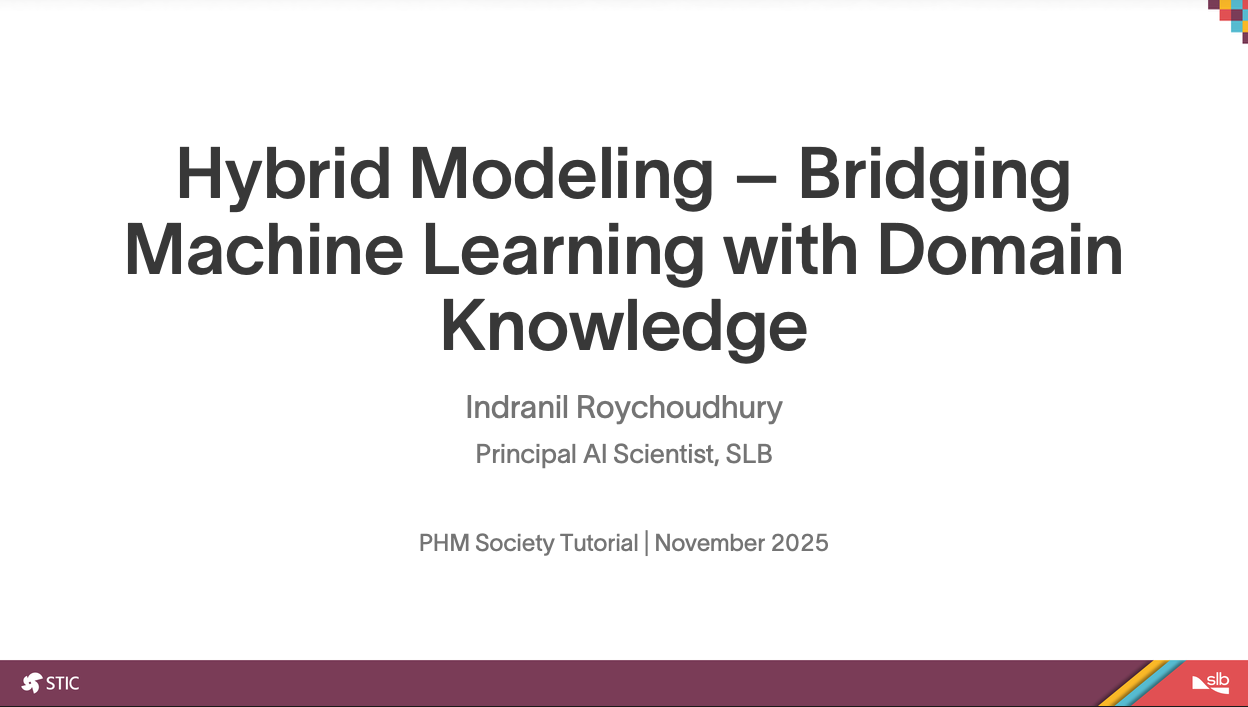
| Tutorial Session 3: Hybrid Modeling: Bridging Machine Learning and Domain Knowledge |
|---|
| Presenters: Indranil Roychoudhury, SLB
Description: Machine learning has shown remarkable success in finding patterns and making predictions, but it often struggles to capture the underlying physics or expert intuition that govern real-world systems. Hybrid Modeling brings these worlds together by blending data-driven learning with domain knowledge — whether that comes from physical laws, mechanistic equations, or years of engineering experience. In this tutorial, we’ll explore how this combination leads to models that are more reliable, interpretable, and efficient. We will also look at examples of Physics-Informed Machine Learning (PIML) and other hybrid approaches that embed scientific principles directly into learning architectures. About the Presenter: Dr. Indranil Roychoudhury is a Principal AI Scientist at SLB’s Software Technology Innovation Center. He has over twenty years of experience in developing algorithms for time series analysis, as well as diagnosis and prognosis algorithms, specializing in systems health management and real-time safety assurance of complex systems such as electrical power distribution systems, water recovery systems, electromechanical actuator testbeds, the National Airspace System, and a variety of complex systems in the energy domain, such as production systems, well construction, and new energy. He received his Ph.D. and MS in CS from Vanderbilt University and was a Senior Research Scientist at NASA Ames before joining SLB. He is a Fellow of the Prognostics and Health Management Society and a Senior Member of IEEE. Slides:
|